— The Cradle of Asian Learning —
Nalanda
Where Ten Thousand Minds Once Met, and a Continent Learned to Think
Best Time
October – March
Recommended Stay
1 night in Rajgir or day-trip from Bodh Gaya
Nearest Airport
Patna (PAT), 90 km
Heritage Status
UNESCO World Heritage Site
The Story
Where Ten Thousand Minds Once Met
“By the time Oxford was a forest and Harvard four centuries from existence, Nalanda had already taught a hundred thousand students and produced libraries so vast they burned for three months.”
In the 5th century CE, when most of the world was still measuring time by harvests, a Gupta emperor founded a residential university on a flat stretch of Magadh's plains. They called it Nalanda Mahavihara — "the great monastery of Nalanda" — and over the next seven hundred years, it became the most important centre of learning the ancient world ever built.
Ten thousand students. Two thousand teachers. Subjects that included logic, grammar, medicine, astronomy, philosophy, metaphysics, mathematics, and twelve schools of Buddhist thought, often debated simultaneously in the same lecture hall. Admission required passing oral examinations at the university's outer gates — the Chinese pilgrim Xuanzang, who arrived in 637 CE and stayed for two years, recorded that only two in ten applicants were accepted. The rejection rate beat modern Ivy Leagues. The faculty were paid from royal endowments. Foreign students from China, Korea, Tibet, Persia, Greece, and Indonesia studied here on scholarship.
Nalanda's libraries were called Ratnasagara ("Ocean of Jewels"), Ratnodadhi ("Sea of Jewels"), and Ratnaranjaka ("Adornment of Jewels"). The Ratnodadhi was nine storeys tall. When Turkic raiders led by Bakhtiyar Khilji burned the university to the ground around 1200 CE, contemporary chronicles say the libraries smouldered for three months — a measure of how vast the manuscript collection was. Some historians estimate that more written knowledge was lost in those three months than in the burning of the Library of Alexandria.
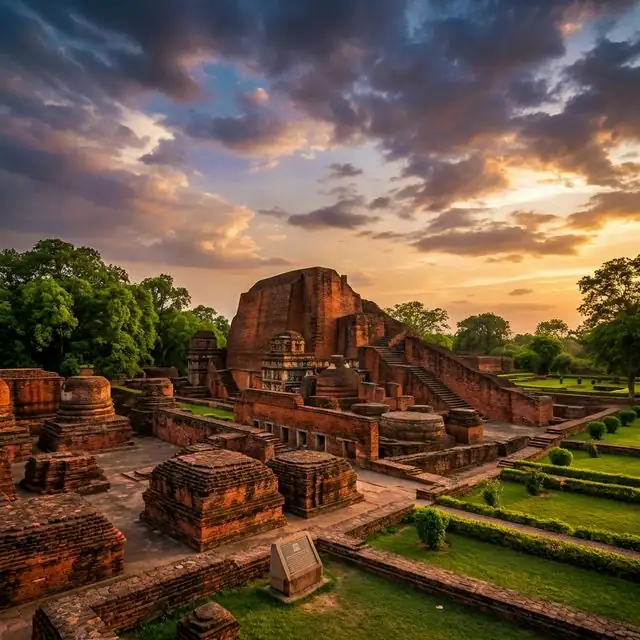
Today you walk through brick. Endless red brick, laid in patterns that have not shifted in 1,500 years. Monastic cells where students slept on stone platforms. Lecture halls where Buddhist logicians debated the nature of perception. The remnants of the great stupa of Sariputra (the Buddha's chief disciple, said to have been born nearby) — its seven layers of architectural revision visible like a sectioned cake. The state of preservation is so remarkable that UNESCO inscribed Nalanda as a World Heritage Site in 2016.
For the discerning traveler, Nalanda is the rarest kind of ruin: an ideas ruin. There are no soaring towers, no dramatic gateways, no Instagram silhouettes. What you walk through are the foundations of arguments — the precise rooms where the Madhyamaka school of Buddhist philosophy refined itself, where successors of Aryabhata taught early algebra, where Tibetan monks like Padmasambhava studied before carrying Buddhism north into the Himalayas and shaping what we now call Tibetan Buddhism.
The newer Nalanda Multimedia Museum offers a 3D walkthrough of the campus at its 8th-century peak — useful, if not poetic. Far more moving is the Xuanzang Memorial Hall, where the Chinese monk's two-year residency is honoured with preserved relics gifted by China. The connection between Nalanda and East Asia — the entire flowering of Mahayana Buddhism in China, Korea, Japan, Vietnam — was made on these very bricks. When Japanese pilgrims visit today, many of them weep before they reach the second courtyard.
Roots & Rounds works with a small group of historians and archaeologists who have spent careers on this site, including alumni of the new Nalanda University founded nearby in 2014 (a 21st-century revival initiated by India and several East Asian governments). They will show you the Sariputra Stupa's seven layers; identify which dormitory housed Korean monks vs Tibetans; explain how the seal-press at Vihara One produced clay tablets that have been excavated from Indonesia to the Caspian.
For HNI travelers, the appeal of Nalanda is intellectual — a destination for those who treat knowledge itself as a form of luxury. We pair Nalanda with afternoon tea at a heritage estate in nearby Pawapuri (the Jain pilgrimage site where Mahavira attained nirvana, just 38 km away), or a private viewing of Pala-era manuscripts at Patna Museum under curator supervision.
Come to Nalanda not for what is left, but for what was thought here. The bricks are merely the punctuation. The real architecture is the curriculum that travelled outward and built half a continent.
A Day in the Life
The Rhythm of Nalanda
Depart your Rajgir hotel after breakfast.
A transcendent encounter designed to unveil the layers of history and spiritual depth that define this sacred topography.
Arrive at Nalanda Archaeological Site as it opens.
A transcendent encounter designed to unveil the layers of history and spiritual depth that define this sacred topography.
Three-hour guided walk with your historian: Vihara, Sariputra Stupa, and monastic cells.
A transcendent encounter designed to unveil the layers of history and spiritual depth that define this sacred topography.
Visit the Nalanda Multimedia Museum for the 3D reconstruction.
A transcendent encounter designed to unveil the layers of history and spiritual depth that define this sacred topography.
Lunch at the new Nalanda University campus or Indo Hokke Hotel.
A transcendent encounter designed to unveil the layers of history and spiritual depth that define this sacred topography.
Visit the Xuanzang Memorial Hall and Hieun Tsang Smriti Mandir.
A transcendent encounter designed to unveil the layers of history and spiritual depth that define this sacred topography.
Optional: drive to Pawapuri for the Jain temple visit at sunset.
A transcendent encounter designed to unveil the layers of history and spiritual depth that define this sacred topography.
Return to Rajgir for the evening.
A transcendent encounter designed to unveil the layers of history and spiritual depth that define this sacred topography.
Curated Experiences
What You'll Experience

Spiritual & Historical Walks
Sariputta Stupa Sunrise Meditation
Guided meditation at Sariputta Stupa within the UNESCO ruins complex before tourist crowds arrive.

Spiritual & Historical Walks
Monastic Ruins Circuit Walk
Scholar-led contemplative walk through excavated cells of Nalanda's ancient monastic university.

Spiritual & Historical Walks
Nava Nalanda Mahavihara Monastery Visit
Private visit to the living monastery and research institute with introduction to resident monks.

Scholarly Retreats
Private Lecture at Nava Nalanda Mahavihara
Private scholarly briefing on Nalanda's curriculum, global legacy and revival.

Scholarly Retreats
Curated Reading Session: Lost Library
Guided reading of primary texts on Nalanda's library — accounts from Xuanzang and Yijing.

Scholarly Retreats
Archaeological Excavation Commentary Tour
Private walk through excavated site with ASI liaison explaining stratigraphy and artefact findings.

Scholarly Retreats
Comparative Religion Scholar Dinner
Intimate dinner with Nalanda scholar on interplay of Buddhism, Brahmanism, and Jainism in ancient Bihar.

Art & Craft Workshops
Madhubani Painting Masterclass
Private 3-hour masterclass with National Award-winning Madhubani master artisan from Mithila. Full composition.

Art & Craft Workshops
Buddhist Manuscript Illumination Introduction
Private session on palm-leaf manuscript preparation and ink illustration inspired by Nalanda's tradition.

Art & Craft Workshops
Terracotta Artisan Workshop
Private session with local terracotta artisan working in tradition of Nalanda-period votive plaques.

Festival Immersions
Nalanda Heritage Festival Access
Private facilitated access to Bihar government's annual Nalanda Heritage Festival — classical dance, scholarly lectures.

Festival Immersions
Full Moon Puja at Nava Nalanda Mahavihara
Private participation in the fortnightly Uposatha full-moon puja at the living monastery with resident monks.

Festival Immersions
Village Harvest Ritual Immersion (Soharai)
Private access to rural Soharai harvest festival near Nalanda — the most important folk festival of Santali & Oraon communities.

Heritage Food Journeys
Heritage Scholar Dinner
Flagship dining experience — intimate dinner for max 4 guests with Nalanda scholar at curated heritage property with wine pairing.

Heritage Food Journeys
Village Women's Kitchen Experience
Private hosted lunch at a village home near Nalanda ruins — traditional recipes and seasonal produce.

Heritage Food Journeys
Bihari Sattu Breakfast Ritual
Curated morning sattu experience — ancient protein-dense Bihar staple — prepared traditionally with raw mango, mustard oil.
Before You Go
Practical Information
Best Time to Visit
October – March (cool, dry; full-day site exploration is comfortable)
Avoid
April – June (intense heat on open archaeological grounds)
Getting Here
Patna Airport (PAT) → 90 km / 2-hr drive. Or day-trip from Rajgir (15 km) or Bodh Gaya (95 km).
Recommended Stay
Stay overnight in Rajgir (15 km away) — better hotels
Where to Stay
Indo Hokke Hotel (Rajgir, Japanese-owned), Hotel Tathagat Vihar, or boutique heritage homestays.
Site Hours
9:00 AM – 5:00 PM (closed Fridays). Arrive at opening for best light.
Sacred Etiquette
Modest dress; speak softly within the ruins.
Photography
Permitted throughout; tripods and pro equipment require ASI permission.
Mobility Notes
Pathways are mostly flat brick; partial wheelchair access. Walking dist ~2 km.
Health & Safety
Carry water, sun protection, and a hat — site is largely unshaded.
Languages You'll Hear
Hindi, Magahi, English
Bonus Stop Nearby
The new Nalanda University campus (11 km away) — visits by appointment.
I'd been to Oxford, Bologna, and Heidelberg. None of them prepared me for the feeling of standing in the lecture hall where logic itself was perfected, fifteen hundred years ago. Our guide didn't tell us about the place — he taught a class while we walked through it.
— Prof. Adrian Wakefield, Cambridge UK · Cultural Immersion, November 2024
Begin Your Exploration
Ready to walk the bricks of Nalanda?
Our scholar-guides will turn ruins into a curriculum — and a curriculum into your most memorable day in Bihar.