— The Eternal City —
Varanasi
Older Than History, Awake Before This Morning's Sun
Best Time
October – March
Recommended Stay
2–3 nights
Nearest Airport
Varanasi (VNS), 25 km
Heritage Status
Hindu Holy City · Buddhist Pilgrimage
The Story
A City That Has Been Waking Before Dawn for Three Thousand Years
“Mark Twain wrote: 'Benares is older than history, older than tradition, older even than legend, and looks twice as old as all of them put together.' He was, for once, not exaggerating.”
Some cities mark time with monuments. Varanasi marks it with the river.
Walk down to the Dashashwamedh Ghat at four in the morning, and you will see something that has been happening, in some recognisable form, for at least three thousand years: a small group of pilgrims standing waist-deep in the Ganga, palms cupped, water spilled toward the rising sun, lips moving in mantras that may be older than Rome. The city itself — known variously as Kashi, Banaras, or Varanasi — is, by most reasonable archaeological measures, the oldest continuously inhabited city in the world. It is named in the Rig Veda. It is mentioned in 6th-century-BCE Buddhist scriptures. It was old when the Buddha walked here. It was old when Akbar's grandmother arrived as a pilgrim. It will outlast the rest of us. That is precisely the appeal.
Varanasi is not in Bihar — it sits across the state line in Uttar Pradesh — but no Bihar journey is complete without it, and no Buddhist circuit is even possible without it. Sarnath, just 13 kilometres north of the city, is where the Buddha gave his first sermon after attaining enlightenment at Bodh Gaya. The two destinations are spiritual siblings: enlightenment in Bihar, transmission in Varanasi. We connect them with a comfortable car journey or, increasingly, the Vande Bharat express train (3.5 hours).
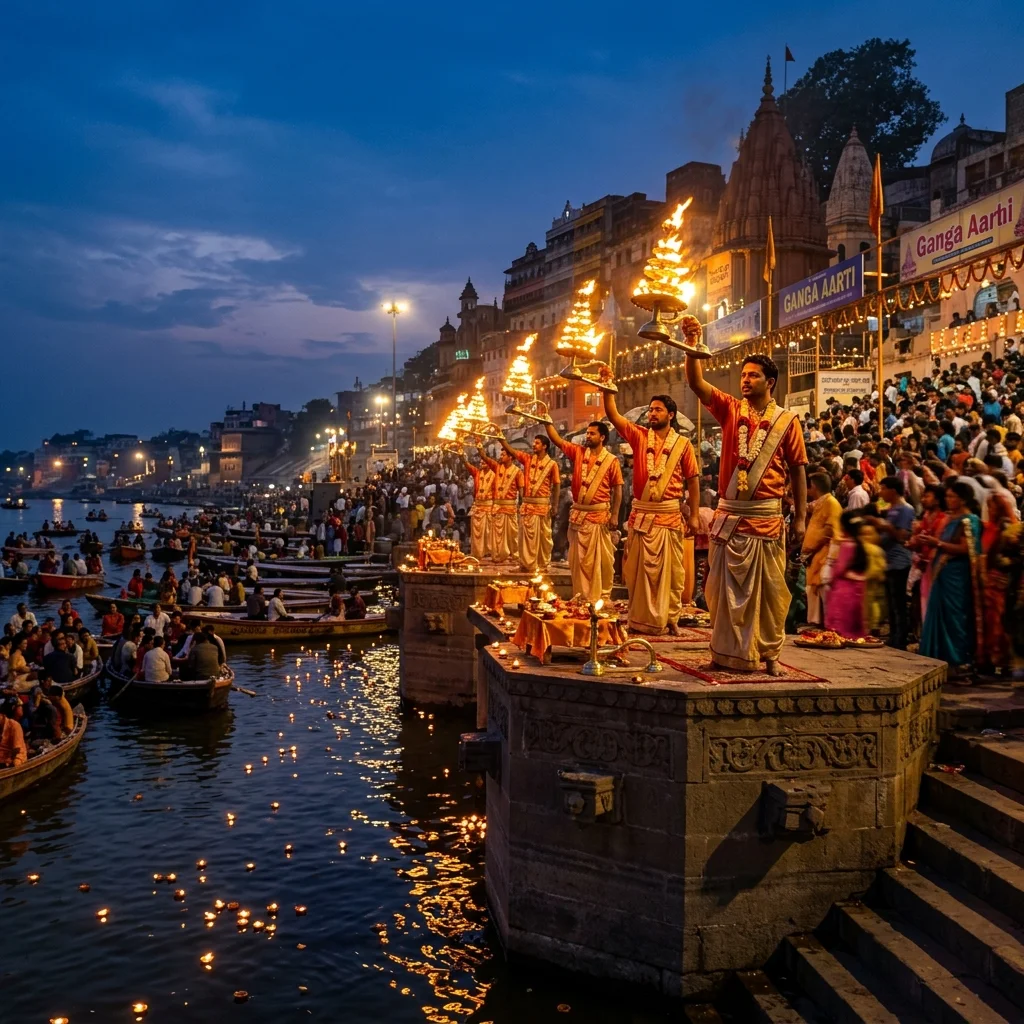
The city's heart is its eighty-eight ghats — broad stone steps descending to the river, each with its own myth and its own rhythm. The grandest is Dashashwamedh — literally "the place of ten horse sacrifices" — where, every evening at dusk, seven priests in saffron perform the Ganga Aarti: an hour-long ceremony of fire, conch shells, bells, and Sanskrit chant that has been performed in some form since at least the 16th century. Witnessing it from a private boat on the river — the priests shrinking against the lit ghat, the chanting drifting across the water, oil lamps floating downstream like a slow procession of stars — is one of the experiences travelers describe years later, often unexpectedly. Even the most secular guests fall silent.
Two ghats matter for a different reason. Manikarnika and Harishchandra are the great cremation grounds, burning around the clock, every day of the year, for as long as anyone has kept records. Hindus believe that to die and be cremated at Varanasi grants moksha — liberation from the cycle of rebirth. The ghats are not photogenic destinations. They are sacred to the dying and the bereaved. We brief our guests in advance on respectful viewing — from a distance, from the river, with no photography — because to understand Varanasi without understanding its quiet relationship with death is to understand only half the city.
For Buddhist travelers, Sarnath is essential. After his enlightenment, the Buddha walked 245 km to Sarnath — then a deer park outside Varanasi — and delivered his first sermon to five companions. That moment, the Dhammacakkappavattana Sutta, set in motion the entire Buddhist tradition. The Dhamekh Stupa marks the spot. The Sarnath Archaeological Museum holds the original Lion Capital of Ashoka — the four-lion sculpture that, twenty-three centuries later, became the emblem of the Republic of India. Standing before it is, for any traveler with even a passing interest in Indian civilisation, a quiet shock.
For HNI travelers, Varanasi rewards the patient and the well-guided. The lanes of the old city are a labyrinth — beautiful, sometimes confronting, and easy to get wrong without context. Roots & Rounds works with scholar-guides who have lived in Varanasi for decades: classical music historians, Sanskrit pundits, hereditary boatmen of the Mallah caste whose families have plied the river for fifteen generations. We arrange private boat journeys at dawn (when the ghats wake quietly), evening Aarti from a private deck-boat (the only respectful way to witness it), silk-weaving demonstrations at master ateliers (the famed Banarasi sari is a 2,000-year-old craft), and private classical music recitals in 17th-century courtyards (Varanasi gave Indian music the Banaras gharana, the lineage that produced Ravi Shankar's mentors).
Come for the river. Stay for the music. Leave with the certainty that you have, however briefly, stood inside one of humanity's longest unbroken conversations with the sacred.
A Day in the Life
The Rhythm of Varanasi
Day 1: Pre-dawn pickup. Private boat journey on the Ganga at sunrise.
A transcendent encounter designed to unveil the layers of history and spiritual depth that define this sacred topography.
Breakfast at a heritage haveli. Visit the Kashi Vishwanath Temple corridor.
A transcendent encounter designed to unveil the layers of history and spiritual depth that define this sacred topography.
Witness the Ganga Aarti from a private deck boat.
A transcendent encounter designed to unveil the layers of history and spiritual depth that define this sacred topography.
Drive to Sarnath. Visit Dhamekh Stupa and the Archaeological Museum.
A transcendent encounter designed to unveil the layers of history and spiritual depth that define this sacred topography.
Day 3: Private Banaras Gharana classical music recital in a haveli courtyard.
A transcendent encounter designed to unveil the layers of history and spiritual depth that define this sacred topography.
Curated Experiences
What You'll Experience

Spiritual & Historical Walks
Dawn Ganga Aarti Private Boat Ceremony
Exclusive private boat for the legendary Dashashwamedh Ghat dawn Ganga Aarti with Brahmin pandit.

Spiritual & Historical Walks
Kashi Vishwanath Inner Sanctum Access
Private facilitated darshan at the Kashi Vishwanath Jyotirlinga — VIP queue bypass with temple scholar.

Spiritual & Historical Walks
Sarnath Deer Park Meditation
Guided meditation at Sarnath — site of the Buddha's First Sermon — within the archaeological garden.

Spiritual & Historical Walks
Old City Sacred Lanes Walk (Antaryami Walk)
Intimate guided walk through Varanasi's ancient alleyways — neighbourhood temples — the world's oldest continuously inhabited city.

Scholarly Retreats
Sarnath Scholar Lecture: The First Sermon
Private lecture at Dhamek Stupa on the Dhammacakkappavattana Sutta — turning of the wheel of Dharma.

Scholarly Retreats
Sanskrit & Vedic Studies Introductory Session
Private session with Varanasi-based Sanskrit pandit at a traditional tol (Sanskrit school) — Vedic chanting.

Scholarly Retreats
Banaras Hindu University Heritage Tour
Private guided tour of BHU's Bharat Kala Bhavan museum — outstanding miniature paintings, sculptures and textiles.

Scholarly Retreats
Intimate Scholar Dinner: Theology of Kashi
Private dinner with Shaiva scholar exploring Varanasi's theological universe — Shiva as Vishwanath.

Art & Craft Workshops
Banarasi Silk Weaving Masterclass
Private session at a traditional Banarasi silk loom learning zari and brocade techniques with a master weaver family.

Art & Craft Workshops
Benaras Ware Brasswork Workshop
Hands-on introduction to Varanasi's legendary brasswork tradition — crafting a small ritual object with artisan.

Art & Craft Workshops
Rudraksha Mala Stringing & Blessing
Meditative session stringing a personalised rudraksha mala with a Shaiva priest — learning bead count significance.

Art & Craft Workshops
Bhairava Mask & Sacred Art Workshop
Private session creating a miniature Bhairava form using traditional Varanasi artistic vocabulary.

Festival Immersions
Dev Deepawali Private Boat & Ghat Access
One million lamps illuminate the ghats for Dev Deepawali. Private boat with attendants, premium position, champagne service.

Festival Immersions
Ganga Aarti VIP Ceremony Access
Private front-row facilitated access to the nightly 7-priest Ganga Aarti at Dashashwamedh Ghat.

Festival Immersions
Mahashivaratri Inner Temple Access
Private pre-dawn darshan at Kashi Vishwanath on Mahashivaratri with Brahmin priest conducting private abhishekam.

Festival Immersions
Ganga Mahotsav Classical Music Festival
Private reserved pavilion access to Varanasi's premier classical music festival — India's finest Hindustani musicians.

Heritage Food Journeys
Sunrise Boat Breakfast on the Ganga
Private boat breakfast at sunrise — Banarasi chai, lal peda, thandai — as the ancient city wakes.

Heritage Food Journeys
Banarasi Chaat & Old City Food Walk
Private guided food walk through labyrinthine lanes — tamatar chaat, baati chokha, pani puri.

Heritage Food Journeys
Haveli Heritage Dinner with Thumri
Intimate dinner in a private Banarasi haveli with live thumri/dadra by BHU-trained classical musician.

Heritage Food Journeys
Malaiyo & Winter Sweets Masterclass
Exclusive seasonal masterclass in preparing Varanasi's legendary malaiyo — morning dew-whipped cream dessert.

Heritage Food Journeys
Royal Banarasi Thali Dinner
Curated royal-style multi-course Banarasi thali at premium heritage property tracing culinary heritage.
Before You Go
Practical Information
Best Time to Visit
October – March (cool, dry). Dev Deepawali (Nov) is spectacular.
Avoid
April – June (45°C+); July – September (monsoon swells the Ganga).
Getting Here
Airport (VNS) — 25 km. Vande Bharat train from Patna (3.5 hrs).
Recommended Stay
2–3 nights minimum; 4 for Dev Deepawali.
Where to Stay
Taj Ganges, BrijRama Palace, Suryauday Haveli, Guleria Kothi.
Sacred Etiquette
Modest dress; strict respect at cremation ghats — no photography.
Photography
Strictly prohibited at Manikarnika and Harishchandra Ghats.
Mobility Notes
Old city lanes are narrow; wheelchair access limited.
Health & Safety
Do not bathe in the Ganga unless following protocol; bottled water only.
Festivals to Catch
Dev Deepawali (Nov), Maha Shivaratri (Feb/Mar), Ganga Mahotsav (Nov).
Languages You'll Hear
Hindi, Bhojpuri, Sanskrit, Pali, Japanese, Thai, English
The Aarti from the boat — that was the moment I realised I'd been a tourist all my life and was finally, for forty minutes, a pilgrim. The next morning at Sarnath, I understood why every rupee on every Indian banknote carries those four lions.
— Marie-Claire Beaumont, Paris · Spiritual Journey, December 2024
Begin Your Exploration
Ready to stand inside the eternal city?
Dawn on the river, Sarnath at midday, Aarti at dusk, and music at midnight — let our specialists craft your three days where time gently bends.